CASE FILE · DD-11
George Adamski — Orthon and the ‘Venusian scout ship’ photographs
01 · OVERVIEW
Case overview
George Adamski (1891–1965) was an early UFO contactee who claimed that on 20 November 1952 he met a Venusian called Orthon near Desert Center, California. Leaving companions at a distance, he said he communicated by gesture and telepathy with a long-haired humanoid who warned about nuclear testing and radiation. On 13 December he said he photographed a bell-shaped ‘Venusian scout ship’ near Mount Palomar through a six-inch telescope and camera. No independent observer examined the encounter at close range and no physical sample establishes it, but the photographs and the 1953 co-authored Flying Saucers Have Landed circulated worldwide. This file therefore asks two separate questions: can the contact and images be verified, and how did the images shape what later audiences imagined—and reported—as a flying saucer?
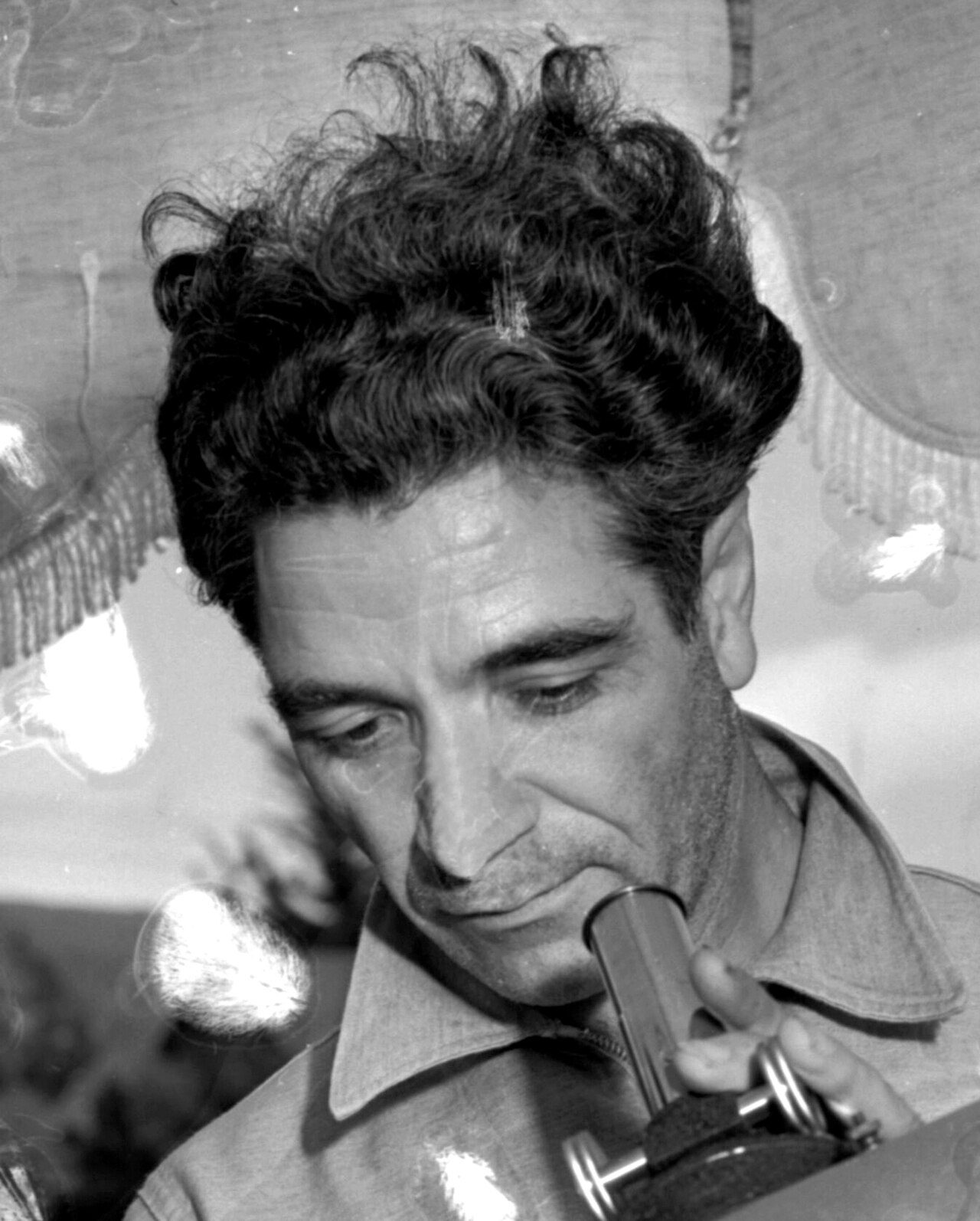
A 1938 record photograph of Adamski before his contactee career. It documents his background, not the later encounter claims.
Los Angeles Times Photographic Collection, UCLA · CC BY 4.0 ↗03 · IMAGE CONTEXT
Image analysis
The telescope helps show the public astronomical persona Adamski cultivated before the 1950s. Its presence does not establish the distance, size or authenticity of the later scout-ship photographs.VISUAL SOURCE SET
Related images and records
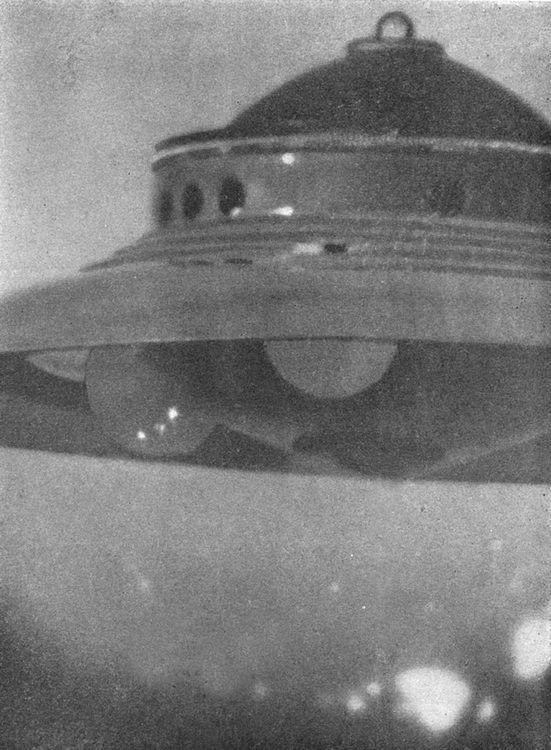
Adamski's iconic ‘scout ship’ image as exhibited by Photo Elysée. The photograph's existence and the object's extraterrestrial origin are separate questions.
The image shows a bell-shaped body, a ring of dark openings and three spherical protrusions below. With no background scale reference, size and distance cannot be fixed from the image alone. This silhouette was repeatedly copied in books, magazines and film and became a visual UFO archetype.
Photograph attributed to George Adamski · copy preserved by UAP Globe ↗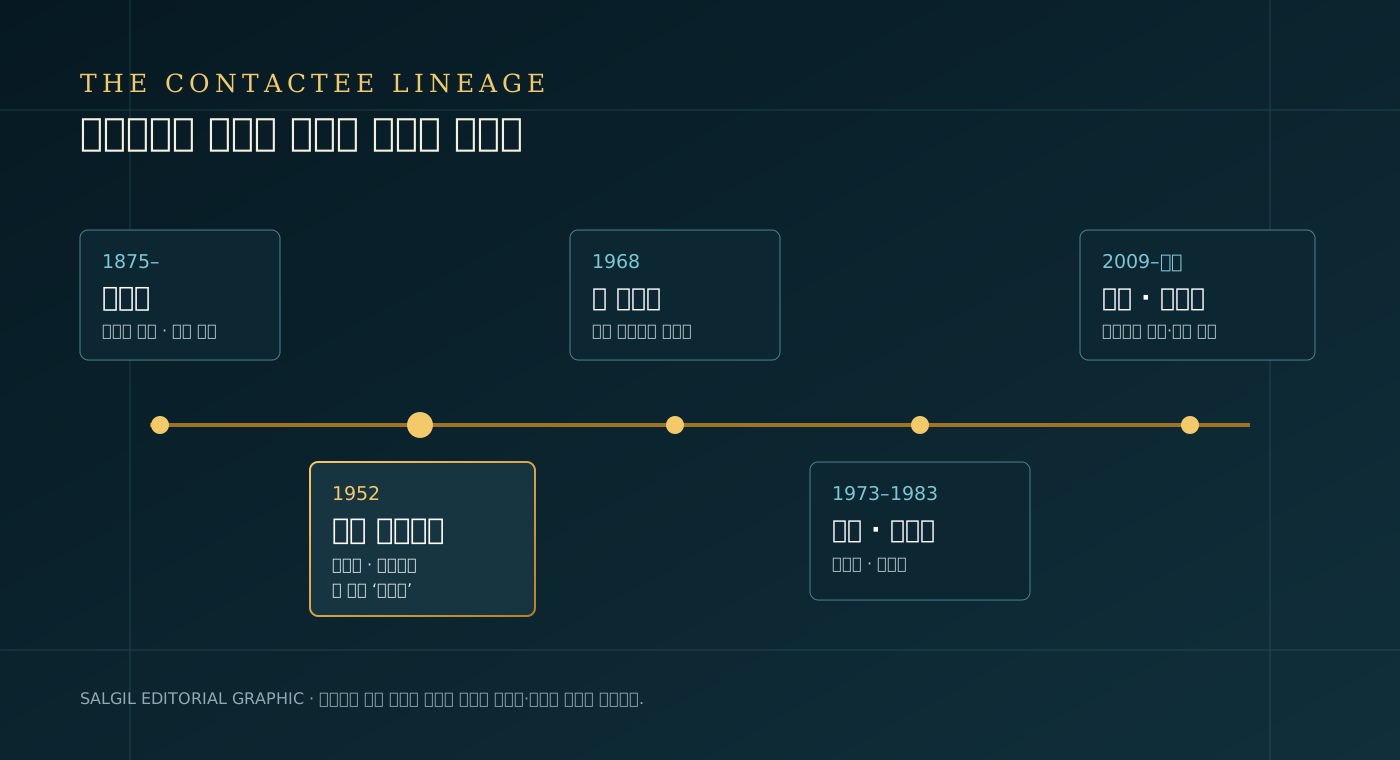
An editorial diagram tracing how Theosophical master narratives passed through Adamski's Space Brothers into UFO religion, channeling and mass media.
The diagram moves from Theosophy in 1875 through Adamski in 1952, von Däniken in 1968, Raëlism in the 1970s, Bashar and later contactee culture, and broadcast/online circulation after 2009. Arrows indicate chronological and structural lineage, not proof of direct copying.
SALGIL original editorial graphic ↗04 · RECORD TIMELINE
Record chronology
Theosophical background
Before his UFO claims, Adamski led the Royal Order of Tibet, blending Asian religious motifs with Theosophical ideas. Its pattern of higher beings instructing a chosen messenger anticipated the later ‘Space Brothers’ narrative.
Claimed encounter with Orthon
Adamski said he met a humanoid Venusian away from his companions. They reported observing Adamski and the scene from a distance, but none independently witnessed the alleged conversation at close range.
Bell-shaped ‘scout ship’ photographs
Images were presented of a bell-shaped body with three spherical protrusions and a ring of window-like details. Repetition in books, magazines, films and models made the silhouette an emblem of the 1950s flying saucer.
Flying Saucers Have Landed published
The book largely divides between Desmond Leslie's ancient-visitation and Theosophical argument and Adamski's contact narrative. Its co-authorship and editorial history mean it should not be treated simply as a book written entirely by Adamski.
Leslie's model-UFO film
At his Irish home, Leslie made the low-budget Them in the Thing using a Spanish shield suspended on fishing line and lit with a mirror. Rediscovered in 2010, it demonstrates period model-film technique but does not prove that Leslie fabricated Adamski's photographs.
Expansion into onboard and planetary journeys
Inside the Space Ships and Flying Saucers Farewell expanded the story into spacecraft interiors, planetary journeys and spiritual teaching. Later planetary science established a hot, high-pressure Venus incompatible with a surface civilization of humanlike Venusians.
Collapse of the ‘Straith letter’
A letter purporting to come from a U.S. State Department official appeared to endorse Adamski. James Moseley later said he and Gray Barker created it as a prank. The letter and related records are preserved by the University of Wyoming's American Heritage Center.
The photograph becomes a cultural template
Regardless of belief in the encounter, the bell-shaped scout ship was endlessly reproduced. Photo Elysée has exhibited the visual lineage that followed Adamski, emphasizing how a photograph can function both as a purported record and as an image that constructs a genre.
05 · EVIDENCE REVIEW
Nature of the evidence
The photographs published from late 1952, companion statements, the 1953 book with Desmond Leslie, the 1955 Inside the Space Ships and international lectures are traceable. Museums and scholarship also document Adamski's influence on UFO photography and early contactee culture.
The meeting with Orthon, the reality of a Venusian scout ship, and later spacecraft journeys remain independently unverified. Competing theories identify different construction parts, but analysis strongly favors a small nearby model over a distant full-size craft. Claims that one exact brooder, surgical lamp or bulb has been conclusively identified require source-level caution.
06 · RELATED CLAIM DOSSIER
Related-claim dossier
What do the 1952 ‘Venusian scout ship’ images show?
The existence of a photograph is not the same as proof that its subject is a Venusian spacecraft. Testing requires separating camera setup, distance, focus, shadow, repeated object details and negative provenance. The file preserves the image as evidence while refusing to assume the size and origin claimed for it.
Core claims
Adamski said he attached a camera to a six-inch telescope to photograph a distant craft. Testing that account requires reproducing focus, depth of field, atmospheric effects and angular size together.
Joel Carpenter's analysis argues for a nearby assembled model rather than a distant craft and compares the main body to a 1930s–1940s pressure-lantern shade. The identification is treated as a reproducible comparison hypothesis, not a definitive peer-reviewed ruling.
Critics have identified different household objects. Repeating resemblance without provenance creates circular citation, so each proposed part must be tied to an analyst and measurable slots, holes or dimensions. The defensible conclusion is that a small-model explanation is strong—not that one commercial product has been established to courtroom certainty.
The silhouette recurred in later photographs, science fiction, television and toys. Similar later reports could be framed as corroboration, but they could equally reflect memory and reporting shaped by a widely learned image.
Source verification
The photographs are primary evidence of what Adamski presented. Without an independent viewpoint or scale reference, however, they cannot establish the object's physical size or distance.
NASA describes a surface near 475°C and pressure roughly 90 times Earth's. That evidence requires an additional explanation for Adamski's humanlike Venusians and surface civilization.
The shield-and-fishing-line film demonstrates how easily a UFO image could be staged in that period. It does not automatically identify the maker of Adamski's separate photographs.
Provisional conclusionVerdict: not established as a Venusian craft / a nearby small model is the stronger explanation. Exact components remain debated, and the photographs cannot establish the claimed distance, scale or extraterrestrial origin.
07 · COUNTERANALYSIS
Counterarguments and disputes
Was he the first contactee?
Claims of alien contact predated Adamski, so this file does not credit him alone with inventing the word or category. He did, however, establish the internationally influential 1950s template: benevolent humanoid visitors, nuclear warning, chosen messenger, photographs, books and lecture tours.
Ghostwriting, co-authorship and source responsibility
Flying Saucers Have Landed combines distinct Leslie and Adamski sections, and research also describes secretarial and editorial shaping of later prose. This does not transfer every claim to Leslie; oral source, writer and editor must be separated claim by claim.
From Theosophy to the Space Brothers
Theosophical ascended masters and ancient wisdom became planetary Space Brothers in Adamski's account. That structure is an important predecessor to later contact and channeling narratives including Raëlism, Bashar and Alex Collier.
A peace message does not verify its source
Warnings about nuclear war and radiation had strong moral force in the early Cold War. Agreement with the message is separate from evidence that a Venusian delivered it.
08 · ASSESSMENT
Evidence assessment
Photographs and a 1953 book appeared early, but independent scene records, negative provenance and physical samples are limited.
Dates, places, companions, an entity name, photographs and messages allow claim-level review.
Images can be tested through optics, parts and reconstruction; a private telepathic conversation cannot.
The main claims were published at the time, but later similar reports must be examined for influence from the already famous Adamski image.
His global influence on early contactee narrative and the bell-shaped saucer image is immense regardless of factual verdict.
Provisional conclusionAssessment: the Orthon encounter and Venusian craft remain independently unverified, and a nearby small model is the stronger explanation for the iconic photographs. The record avoids both overclaiming one exact household object and reducing the person to a label. Adamski matters historically because his combination of Theosophical Space Brothers and a bell-shaped scout ship became a visual and narrative template repeated by later contactees, UFO religions and media.
09 · COMPARATIVE FILE
Comparative record
Compare with the International Raëlian Movement
Adamski globalized the Space Brother and chosen-messenger template; Raëlism institutionalized a related extraterrestrial-creator narrative through an international movement, embassy project and biotechnology claims. Together they show how personal contact stories can become organized religion.
Open comparison →10 · SOURCE TRAIL