CASE FILE · DD-08
1961 Betty and Barney Hill case
01 · OVERVIEW
Case overview
Betty and Barney Hill said that on the night of 19 September 1961, while driving south on U.S. Route 3 through New Hampshire after a trip to Canada, they observed a bright light moving in the sky. Near Indian Head, Barney said he viewed the light through binoculars and perceived windows and humanoid figures before the couple drove away. They later noticed that more time had passed than expected and that part of the journey was unclear in memory—the basis of the ‘missing time’ claim. The now-famous account of boarding, medical examinations, beings and a star map was not a complete contemporaneous statement from that night. It developed through Betty's recurring dreams and separate hypnosis sessions conducted by psychiatrist Benjamin Simon in 1964. This file therefore separates the conscious 1961 sighting, early reporting and investigation, 1964 hypnotic recall, and the star-map interpretation developed from 1968 onward.
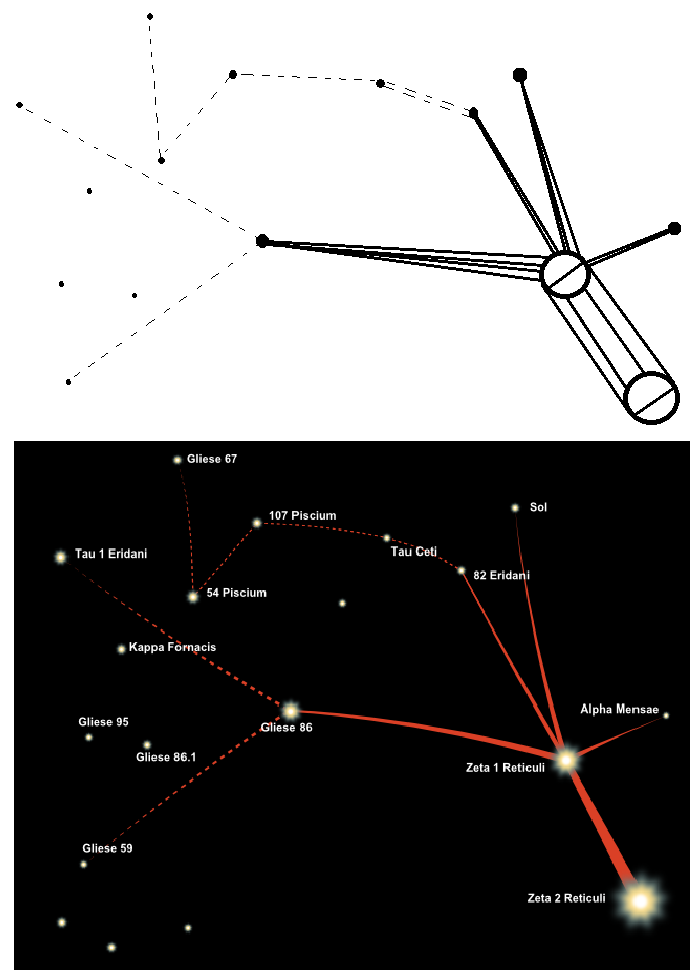
A comparison between the star sketch associated with hypnotic recall and a later Zeta Reticuli reconstruction; the match does not prove contact.
Wikimedia Commons · case visual record ↗03 · IMAGE CONTEXT
Image analysis
This later diagram compares Betty Hill's recalled sketch with an astronomical reconstruction. The apparent match can change depending on which stars are selected, how the map is rotated and how points are connected. It documents how the Zeta Reticuli interpretation was constructed rather than proving the original memory.04 · RECORD TIMELINE
Record chronology
Bright object reported along U.S. Route 3
The couple said they repeatedly watched a light while driving south through northern New Hampshire. Barney reported viewing it through binoculars near Indian Head before returning to the car in fear. This conscious sighting is not the same evidentiary layer as the later boarding narrative.
Report to Pease Air Force Base
Betty contacted Pease Air Force Base and reported the observation; the Air Force record preserved a description of a bright, telescopic-looking object. The document supports that a sighting was reported, not that an abduction occurred.
NICAP contact and Walter Webb investigation
Betty wrote to NICAP and investigator Walter Webb, who had astronomical observing experience, interviewed the couple. The pre-hypnosis report is important, but Webb worked for a UFO research organization and his conclusion was not an official government finding.
Betty's recurring dreams
After the event, Betty recorded recurring dreams involving a blocked road, entry into a craft and examinations. Because these dreams preceded the 1964 hypnosis, a central question is whether later scenes were independent memories of the night or a replay and elaboration of an already-formed dream narrative.
Benjamin Simon's separate hypnosis sessions
Psychiatrist Benjamin Simon interviewed the Hills separately and recorded hypnosis sessions intended to address anxiety and the memory gap. Boarding, examinations, conversations with beings and the star map became detailed in this process. The recordings are genuine primary material, but they do not automatically establish the accuracy of hypnotic recall.
Public exposure and The Interrupted Journey
The story became public through Boston Traveler reporting and Look magazine, followed by John G. Fuller's 1966 book The Interrupted Journey, based on the hypnosis material. Later memories and interpretations must therefore be evaluated in light of growing media exposure.
Marjorie Fish's 3D model and Zeta Reticuli interpretation
Using nearby-star catalogues, Marjorie Fish built several bead-and-string three-dimensional models and searched them from different viewing angles for a resemblance to Betty's sketch. She matched about fifteen nearby stars, including the Sun, around the Zeta Reticuli pair; a debated 1974 Astronomy magazine article popularized the interpretation.
Archival preservation and continuing review
The University of New Hampshire preserves correspondence, journals, manuscripts, photographs, recordings and star-map correspondence. The existence of an archive must be distinguished from validation of the extraordinary claims contained in it.
05 · EVIDENCE REVIEW
Nature of the evidence
The Hills' 1961 reporting, Walter Webb's early investigation, recordings of the 1964 hypnosis sessions, Betty's star sketch and related correspondence survive, with archival material held by the University of New Hampshire.
The identity of the light, the cause of the roughly two-hour gap, the factuality of the hypnotically recalled abduction and examinations, and the claimed correspondence with Zeta Reticuli have not been independently verified.
06 · RELATED CLAIM DOSSIER
Related-claim dossier
Betty Hill's star map and the Zeta Reticuli interpretation
The star map is the case's most famous visual, but it is not a single extraterrestrial route chart. It is a layered construction: Betty's two-dimensional memory sketch, Marjorie Fish's three-dimensional nearby-star models, and a Zeta Reticuli correspondence found from a selected viewing angle.
Core claims
Betty recalled a map that appeared flat yet conveyed depth, with two large points, smaller points and different connecting lines. In the hypnosis account and later retellings, the being allegedly described solid or heavier lines as regular trade routes and broken lines as occasional expeditions. She said many background stars were present but she drew only the prominent remembered points and lines.
The drawing has no north direction, coordinates, scale, calibrated point brightness, viewing distance or projection method. It was drawn after hypnosis roughly two years and four months after the event, not at the 1961 scene. Any astronomical comparison therefore requires prior rules for rotation and point selection.
Fish used the Gliese Catalogue of Nearby Stars and other data to build multiple bead-and-string three-dimensional models. From 1968 to 1973 she searched different viewpoints and proposed that, if Zeta 1 and Zeta 2 Reticuli were the two large points, about fifteen nearby stars including the Sun resembled the sketch's main points. She interpreted the lines as trade or expedition routes radiating from Zeta Reticuli.
Zeta Reticuli is a wide physical pair of Sun-like stars in the southern constellation Reticulum, about 39 light-years away. The two stars are only barely visible to the unaided eye and share common motion while remaining widely separated. Those astronomical facts do not imply an inhabited planetary civilization or visits to Earth.
Proponents argue that the matched points concentrate on relatively nearby Sun-like stars rather than random background stars and that the lines look like plausible exploration routes when centered on Zeta Reticuli. The 1974 Astronomy article presented this as an intriguing astronomical problem, not as proof of extraterrestrial visitation.
Source verification
The sketch dates to 1964, Fish's search began in 1968, and broad publication came in 1974. The match was not a pre-event prediction; it was a post hoc search through real star catalogues after the case narrative was known.
Rotating a three-dimensional star field, moving the viewpoint and choosing which stars and lines to include creates many possible patterns. Critics have produced other stellar combinations with visual similarities. Because this was not a blind test with candidates fixed in advance, resemblance alone cannot rule out chance.
Fish's model used the era's distance and spectral data plus assumptions about which stars might support life. Later, more precise parallax measurements and classifications altered some positions and suitability assumptions. This does not yield a single simple falsification of Betty's sketch; it shows that the proposed match is sensitive to catalogue choices and assumptions.
Zeta Reticuli and the nearby stars were known to astronomy before Betty's sketch. Later catalogues such as the 1969 Gliese edition supplied improved measurements, but that is entirely different from Betty discovering previously unknown stars.
A stronger test would pre-register point selection, line rules and error tolerances, then apply them across the full modern nearby-star catalogue to calculate how often comparable matches occur. A blind comparison by analysts unfamiliar with the target sketch and publication of alternative models would be needed to assess uniqueness.
Provisional conclusionVerdict: a historically important retrospective astronomical match, not independent evidence of an extraterrestrial route map. The visual resemblance between the sketch and Fish's model belongs in the record, but timing, selection freedom and absent coordinates prevent identifying Zeta Reticuli as its proven origin.
07 · COUNTERANALYSIS
Counterarguments and disputes
The sighting report and abduction memory are not contemporaneous
The 1961 report supports that a bright object was reported. Detailed boarding, examination and entity scenes emerged through recurring dreams and hypnosis about two years and four months later. The early sighting report cannot be expanded into a contemporaneous record of abduction.
Hypnosis is not a tool that verifies memory accuracy
Modern research summarized by the American Psychological Association does not support the belief that hypnosis makes memory more accurate; it can increase false memories and unwarranted confidence. Session recordings document what was said, not that the described events occurred.
Separate interviews reduced but did not eliminate contamination
Proponents stress that Simon hypnotized the Hills separately and tried to limit cross-communication between sessions. Yet the couple had already discussed the event and Betty's dreams, while interview prompts, expectations and cultural imagery remained possible influences on reconstructed memory.
A time discrepancy was reported, but its cause is undetermined
The Hills' sense that their arrival time and part of the route were anomalous is central to the case. Without precise contemporaneous departure and arrival records, continuous location data or independent witnesses, the roughly two hours cannot be assigned to an alien abduction.
The star map is a retrospective pattern match
Betty's sketch was not drawn at the 1961 scene; it was produced from memory after hypnosis in 1964. Fish's match was then found from 1968 onward by testing updated star catalogues, multiple models and viewing angles, so it was not an independent prediction made in advance.
Zeta Reticuli was not a star system discovered by Betty
Zeta 1 and Zeta 2 Reticuli are an already-known nearby stellar pair about 39 light-years away in Reticulum. The dispute is whether dots in the sketch resemble a three-dimensional arrangement centered on those stars—not whether Betty discovered stars unknown to astronomy.
08 · ASSESSMENT
Evidence assessment
A 1961 report and early investigation exist, but the most extraordinary abduction, examination and star-map content became detailed in 1964 hypnosis.
The route, timing, observational actions and hypnotic statements are detailed, but specificity alone does not establish truth.
There is no craft photograph, raw radar record, recovered material or independent boarding witness. Later claims about the car and clothing do not establish a cause.
Recurring dreams, discussion between the couple, hypnosis and prolonged media exposure create substantial risk of reconstructed memory and increased confidence.
The sketch lacks scale, coordinates, orientation and brightness rules, while star selection and three-dimensional viewpoint can be adjusted; no adequate statistical procedure excludes chance resemblance.
Provisional conclusionVerdict: an important case in modern UFO cultural history with early reporting and a rich documentary trail, but the abduction and entities remain unverifiable. Its strongest evidence is the 1961 sighting report and subsequent provenance; its weakest link is treating hypnotic recall as factual event memory. The star map is better evidence of how 1960s–1970s astronomy, hypnosis and UFO research combined to produce an interpretation than of an extraterrestrial journey.
09 · COMPARATIVE FILE
Comparative record
Compare with the 1975 Travis Walton case
Both are emblematic abduction narratives, but the Hill case centers on hypnotic recall and a star-map interpretation, while Walton's centers on coworkers' sighting claims and a documented absence. They allow a comparison of conscious observation, confirmed gaps and later narrative.
Open comparison →10 · SOURCE TRAIL