ENGLISH RECORD 16
Daniel's Four Kingdoms
The Hebrew and Aramaic text is ancient; the identity and endpoint of the kingdoms depend on interpretive tradition.Second-century BCE text with later traditionsJudea · Near EastBiblical apocalypse · empire
01 · WHAT IT IS
Overview
Daniel 2 and 7 present successive kingdoms through a statue and four beasts, followed by divine rule.
02 · ORIGINAL TEXT AND EARLIEST SOURCE
What can be traced?
03 · HISTORICAL BACKGROUND
The world behind the text
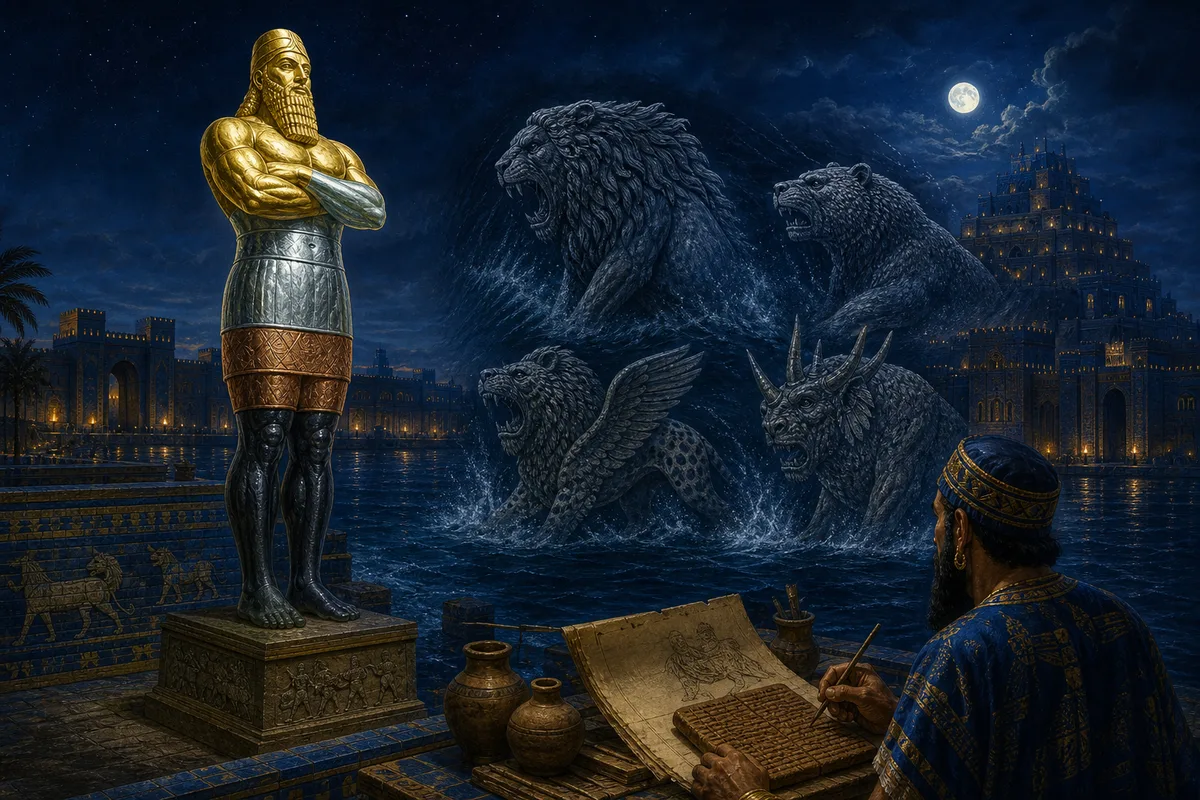
An original editorial reconstruction created specifically for this archive record. It visualizes the subject and is not documentary evidence or an authenticated historical image.
SALGIL original illustration · record sources below ↗05 · DOCUMENT TIMELINE
When the record changed
- Earliest reviewable baselineSefaria · Daniel 7 anchors the first layer used on this page.
- Interpretation expandsAncient Jewish setting · Christian imperial schemes · modern prophecy charts
- Claim meets outcomeMany scholars read the sequence through the Hellenistic crisis; later systems extend it to Rome or modern powers.
- SALGIL editorial reviewOriginal, interpretation and outcome are retained as separate records.
06 · EDITION AND WITNESS COMPARISON
How the evidence for Daniel's Four Kingdoms changes
The date of a document and the date of an interpretation are recorded separately.| Witness or edition | Date | Editorial status | Why it matters |
|---|---|---|---|
| Sefaria · Daniel 7 | 2nd century BCE | Baseline source | The Hebrew and Aramaic text is ancient; the identity and endpoint of the kingdoms depend on interpretive tradition. |
| Scholarly or institutional interpretation | Later review | Context layer | Explains language, history and uncertainty without becoming the original text. |
| Viral quotation or modern event match | Recent circulation | Derivative layer | Most vulnerable to translation drift, omitted failures and hindsight; compare with Sefaria · Daniel 7. |
07 · MAJOR CLAIMS
Representative claims and their limits
Central claim
Four symbolic kingdoms culminate in judgment and an enduring kingdom.
Original-first test
The claim is checked against Sefaria · Daniel 7, not against a later summary.
Outcome test
Many scholars read the sequence through the Hellenistic crisis; later systems extend it to Rome or modern powers.
08 · WHAT ACTUALLY HAPPENED
Comparison with events
Many scholars read the sequence through the Hellenistic crisis; later systems extend it to Rome or modern powers.09 · DISPUTES AND COUNTERARGUMENTS
Where interpretation changes
The main dispute concerns the distance between 2nd century BCE and Ancient Jewish setting · Christian imperial schemes · modern prophecy charts. Translation, selective quotation, changed definitions and hindsight can make a broad record appear more exact than it was. Competing readings are therefore preserved rather than silently merged.10 · EVIDENCE SCORE & PROVISIONAL CONCLUSION
Source strong · interpretation disputed
Daniel 2 and 7 present successive kingdoms through a statue and four beasts, followed by divine rule. SALGIL's provisional score reflects source traceability and testability, not religious worth or cultural importance.11 · SOURCES AND REVIEW