ENGLISH RECORD 115
Morgan Robertson’s Futility and the Titanic
The 1898 text predates the disaster, but post-Titanic editions changed some figures; every comparison must identify the edition used.01 · WHAT IT IS
Overview
Morgan Robertson's novella described the loss of a giant liner named Titan fourteen years before Titanic sank, creating one of the best-known ‘fiction predicted reality’ cases.
02 · ORIGINAL TEXT AND EARLIEST SOURCE
What can be traced?
03 · HISTORICAL BACKGROUND
The world behind the text
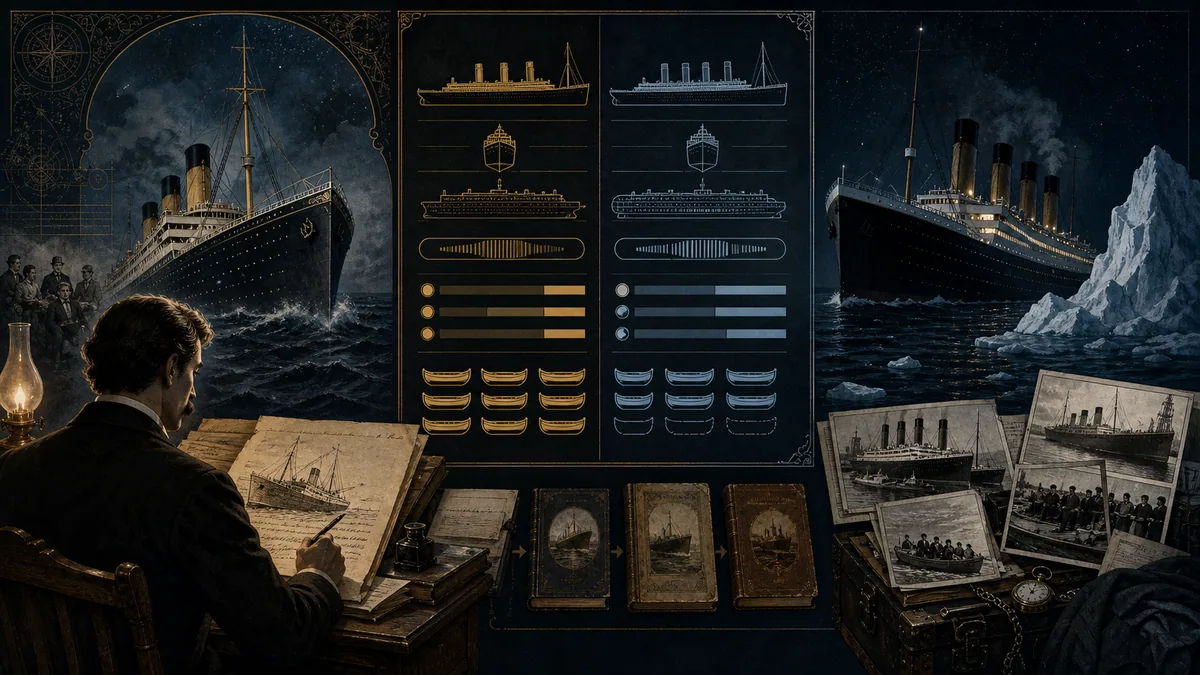
An original editorial reconstruction created specifically for this archive record. It visualizes the subject and is not documentary evidence or an authenticated historical image.
SALGIL original illustration · record sources below ↗05 · DOCUMENT TIMELINE
When the record changed
- Earliest reviewable baselineProject Gutenberg · Futility anchors the first layer used on this page.
- Interpretation expands1898 edition · 1912 disaster · revised edition · viral comparison table
- Claim meets outcomeThe name, iceberg and lifeboat shortage are striking, but dimensions, speed, route, impact and casualties differ, and the novel did not claim prophecy.
- SALGIL editorial reviewOriginal, interpretation and outcome are retained as separate records.
06 · EDITION AND WITNESS COMPARISON
How the evidence for Morgan Robertson’s Futility and the Titanic changes
The date of a document and the date of an interpretation are recorded separately.| Witness or edition | Date | Editorial status | Why it matters |
|---|---|---|---|
| Project Gutenberg · Futility | 1898 first edition | Baseline source | The 1898 text predates the disaster, but post-Titanic editions changed some figures; every comparison must identify the edition used. |
| Scholarly or institutional interpretation | Later review | Context layer | Explains language, history and uncertainty without becoming the original text. |
| Viral quotation or modern event match | Recent circulation | Derivative layer | Most vulnerable to translation drift, omitted failures and hindsight; compare with Project Gutenberg · Futility. |
07 · MAJOR CLAIMS
Representative claims and their limits
Central claim
A supposedly secure liner named Titan strikes North Atlantic ice in April with too few lifeboats and enormous loss of life.
Original-first test
The claim is checked against Project Gutenberg · Futility, not against a later summary.
Outcome test
The name, iceberg and lifeboat shortage are striking, but dimensions, speed, route, impact and casualties differ, and the novel did not claim prophecy.
08 · WHAT ACTUALLY HAPPENED
Comparison with events
The name, iceberg and lifeboat shortage are striking, but dimensions, speed, route, impact and casualties differ, and the novel did not claim prophecy.09 · DISPUTES AND COUNTERARGUMENTS
Where interpretation changes
The main dispute concerns the distance between 1898 first edition and 1898 edition · 1912 disaster · revised edition · viral comparison table. Translation, selective quotation, changed definitions and hindsight can make a broad record appear more exact than it was. Competing readings are therefore preserved rather than silently merged.10 · EVIDENCE SCORE & PROVISIONAL CONCLUSION
Pre-event text exists · edition differences
Morgan Robertson's novella described the loss of a giant liner named Titan fourteen years before Titanic sank, creating one of the best-known ‘fiction predicted reality’ cases. SALGIL's provisional score reflects source traceability and testability, not religious worth or cultural importance.11 · SOURCES AND REVIEW