ENGLISH RECORD 30
Apocalyptic Symbols in Modern Politics
Speeches and publications can be documented, but symbolic rhetoric is not evidence that an ancient prophecy names a current state.Modern political communicationGlobalPolitics · religious rhetoric
01 · WHAT IT IS
Overview
Political movements use Armageddon, Babylon, antichrist and chosen-nation language to frame conflict as an absolute struggle.
02 · ORIGINAL TEXT AND EARLIEST SOURCE
What can be traced?
03 · HISTORICAL BACKGROUND
The world behind the text
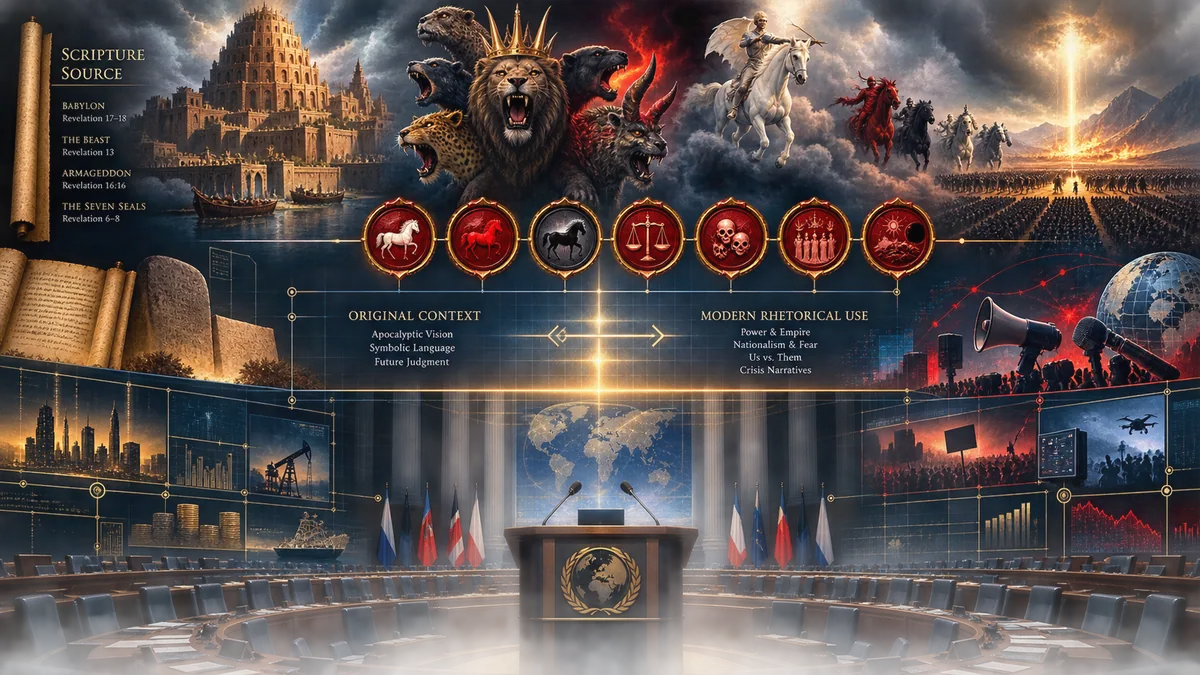
An editorial visualization of how ancient apocalyptic symbols are reused in modern political rhetoric; no real politician or party is depicted.
SALGIL original illustration · record sources below ↗05 · DOCUMENT TIMELINE
When the record changed
- Earliest reviewable baselinePew Research Center · Religion and public life anchors the first layer used on this page.
- Interpretation expandsPrinted sermons · mass media · social-platform mobilization
- Claim meets outcomePredictions often change when governments, enemies or elections change, revealing political adaptation.
- SALGIL editorial reviewOriginal, interpretation and outcome are retained as separate records.
06 · EDITION AND WITNESS COMPARISON
How the evidence for Apocalyptic Symbols in Modern Politics changes
The date of a document and the date of an interpretation are recorded separately.| Witness or edition | Date | Editorial status | Why it matters |
|---|---|---|---|
| Pew Research Center · Religion and public life | 19th–21st centuries | Baseline source | Speeches and publications can be documented, but symbolic rhetoric is not evidence that an ancient prophecy names a current state. |
| Scholarly or institutional interpretation | Later review | Context layer | Explains language, history and uncertainty without becoming the original text. |
| Viral quotation or modern event match | Recent circulation | Derivative layer | Most vulnerable to translation drift, omitted failures and hindsight; compare with Pew Research Center · Religion and public life. |
07 · MAJOR CLAIMS
Representative claims and their limits
Central claim
Apocalyptic language can mobilize identity, urgency and sacrifice.
Original-first test
The claim is checked against Pew Research Center · Religion and public life, not against a later summary.
Outcome test
Predictions often change when governments, enemies or elections change, revealing political adaptation.
08 · WHAT ACTUALLY HAPPENED
Comparison with events
Predictions often change when governments, enemies or elections change, revealing political adaptation.09 · DISPUTES AND COUNTERARGUMENTS
Where interpretation changes
The main dispute concerns the distance between 19th–21st centuries and Printed sermons · mass media · social-platform mobilization. Translation, selective quotation, changed definitions and hindsight can make a broad record appear more exact than it was. Competing readings are therefore preserved rather than silently merged.10 · EVIDENCE SCORE & PROVISIONAL CONCLUSION
Source and context required
Political movements use Armageddon, Babylon, antichrist and chosen-nation language to frame conflict as an absolute struggle. SALGIL's provisional score reflects source traceability and testability, not religious worth or cultural importance.11 · SOURCES AND REVIEW