ENGLISH RECORD 02
Book of Revelation
Ἀποκάλυψις Ἰωάννου · Apocalypse of John01 · WHAT IT IS
Overview
An early Christian apocalypse addressed to seven churches in Roman Asia. Through visions of beasts, seals, trumpets and judgment, it imagines the defeat of oppressive power and the renewal of creation.
02 · ORIGINAL TEXT AND EARLIEST SOURCE
What can be traced?
03 · HISTORICAL BACKGROUND
The world behind the text
REVELATION SPECIAL ARCHIVE · TEXT AND HISTORY
An imperial-age letter before it became a code of fear
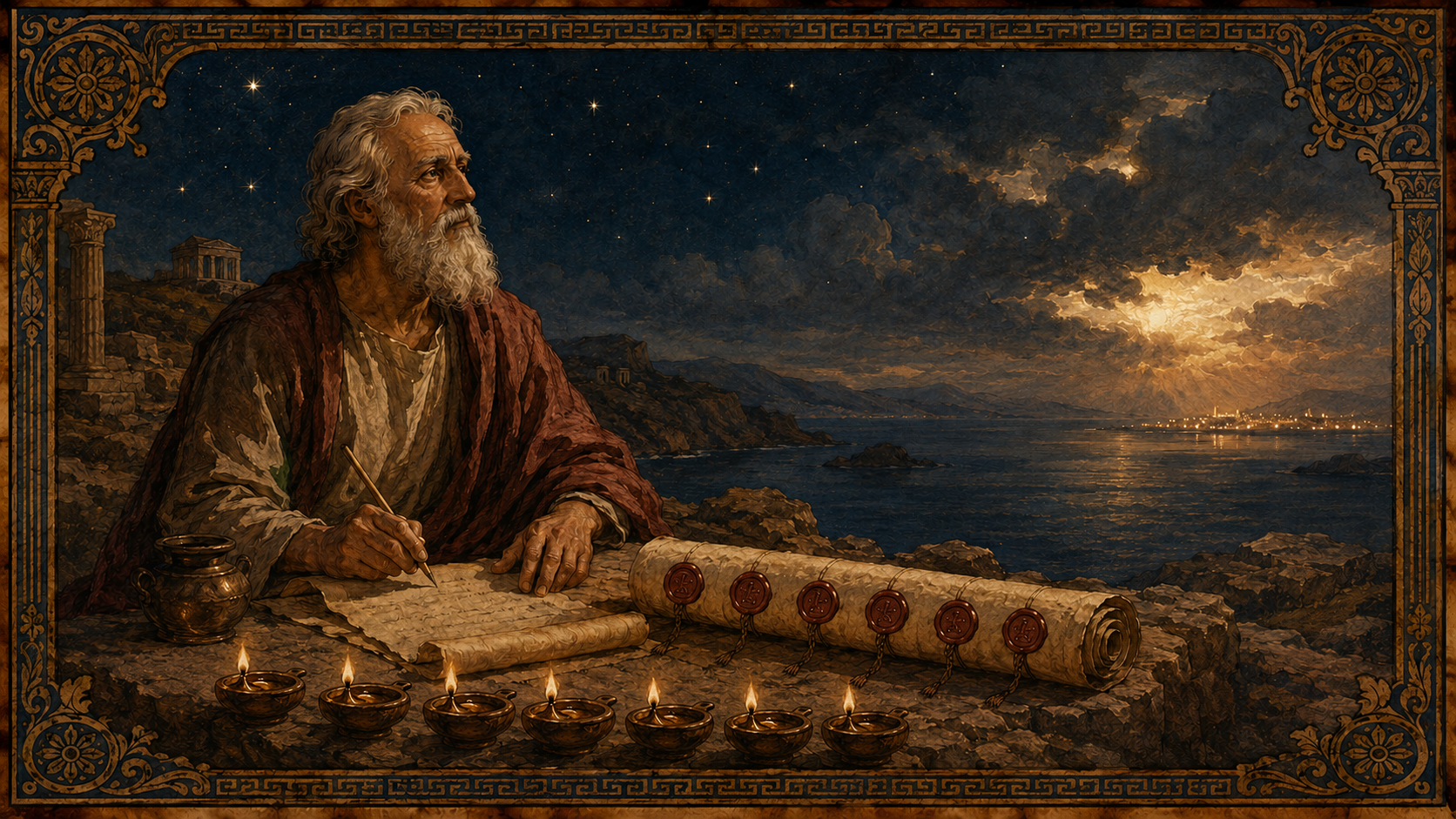
Revelation presents visions received by a writer who calls himself John on Patmos and addresses seven churches in Roman Asia. It combines letter, prophecy and apocalypse, using symbolic language to imagine the defeat of violent power and the renewal of creation.
- Greek title
- Ἀποκάλυψις Ἰωάννου
- Addressees
- Ephesus, Smyrna, Pergamum, Thyatira, Sardis, Philadelphia and Laodicea
- Common dating
- Often placed near the end of the first century, though debate continues
- Final horizon
- Not judgment alone, but new creation and the healing of the nations
- 01Seven churches of Roman Asia
Exhortation to real communities sits beside symbolic criticism of imperial power.
- 02Reading and canon debate
The work circulated widely while authorship, interpretation and canonical standing were debated.
- 03Major Greek codices
The text is preserved in major biblical manuscripts including Codex Sinaiticus.
- 04Repeated remapping
Empires, churches, wars and revolutions were variously identified with its beasts and Babylon.
- 05News-code readings
Barcodes, computers, vaccines, states and public figures are repeatedly linked to 666; those claims must be separated from the ancient text.
RECORD 01 · REVELATION 2–3
The seven churches — seven diagnoses sent to real communities
Open each entry for praise, rebuke, call, promise and urban setting.01EphesusRev 2:1–7 · Hard-working and discerning, yet charged with abandoning its first love.+
- Praise
- Labor, endurance and testing false apostles
- Rebuke
- Abandoning the love held at first
- Call
- Remember, repent and recover the former works
- Promise
- Access to the tree of life
- Urban setting
- A major Asian port and center associated with Artemis
02SmyrnaRev 2:8–11 · A community called to faithfulness amid poverty, slander and persecution.+
- Praise
- Spiritual wealth amid affliction and poverty
- Rebuke
- No direct rebuke
- Call
- Do not fear the coming test; remain faithful to death
- Promise
- The crown of life and safety from the second death
- Urban setting
- A port where civic loyalty and imperial cult could create pressure
03PergamumRev 2:12–17 · Faithful under pressure but exposed to accommodation with its religious environment.+
- Praise
- Holding fast even after Antipas was killed
- Rebuke
- Some hold the teaching of Balaam and the Nicolaitans
- Call
- Repent and confront accommodation
- Promise
- Hidden manna and a white stone with a new name
- Urban setting
- An administrative and cultic center with temples and imperial worship
04ThyatiraRev 2:18–29 · Growing in love and service while tolerating damaging teaching within.+
- Praise
- Love, faith, service, endurance and growing works
- Rebuke
- Tolerating the teacher called ‘Jezebel’
- Call
- Those not following the teaching should hold fast
- Promise
- Authority over the nations and the morning star
- Urban setting
- Trade guilds linked work, meals and religious practice
05SardisRev 3:1–6 · A community with a reputation for life but judged to be asleep.+
- Praise
- A few have not soiled their clothes
- Rebuke
- A living reputation concealing spiritual death
- Call
- Wake up, strengthen what remains and remember what was received
- Promise
- White robes and a name retained in the book of life
- Urban setting
- A city remembered for confident defenses breached through inattention
06PhiladelphiaRev 3:7–13 · A small community praised for keeping the word and not denying the name.+
- Praise
- Faithfulness despite little power
- Rebuke
- No direct rebuke
- Call
- Hold fast so no one takes the crown
- Promise
- A pillar in the temple bearing divine and New Jerusalem names
- Urban setting
- An earthquake-prone inland city and conduit of Hellenistic culture
07LaodiceaRev 3:14–22 · Materially confident but diagnosed as lukewarm and poor.+
- Praise
- No direct praise
- Rebuke
- Lukewarm self-satisfaction
- Call
- Acquire refined gold, white clothing and eye salve; become earnest and repent
- Promise
- A place with Christ on the throne
- Urban setting
- A wealthy center of finance, textiles and medicine dependent on aqueducts
RECORD 02 · REVELATION 5:1–8:1
The seven seals — the Lamb opens the scroll
The four riders are followed by martyrs, cosmic collapse and silence.01White horseRev 6:1–2 · Its rider receives bow and crown and rides out conquering.+
- Symbols
- White, bow, crown
- Past-oriented
- Imperial conquest and expansion
- Symbolic
- The appetite for conquest begins a chain of disaster
- Futurist
- A final conqueror, deceiver or victorious figure
02Red horseRev 6:3–4 · Its rider removes peace so that people kill one another and receives a great sword.+
- Symbols
- Red, great sword, removed peace
- Past-oriented
- War and civil conflict in the Roman world
- Symbolic
- Recurring collective violence
- Futurist
- A final global war
03Black horseRev 6:5–6 · Grain is priced near a day's wage while oil and wine remain untouched.+
- Symbols
- Black, scales, inflated grain price
- Past-oriented
- Shortage and price control after war
- Symbolic
- Scarce necessities beside protected luxuries
- Futurist
- A final economic crisis
04Pale green horseRev 6:7–8 · Death rides, Hades follows, and sword, famine, death and wild beasts converge.+
- Symbols
- Pale green, Death, Hades
- Past-oriented
- Composite war, famine and disease
- Symbolic
- Cascading death after social collapse
- Futurist
- Large-scale final judgment
05Souls beneath the altarRev 6:9–11 · Those killed for their testimony call for justice and receive white robes.+
- Symbols
- Altar, white robes, ‘a little longer’
- Past-oriented
- Memory of early Christian persecution
- Symbolic
- The demand for justice by victims
- Futurist
- Completion of final martyrdom
06Earthquake and collapsing skyRev 6:12–17 · Earth, sun, moon, stars and sky convulse while every social rank seeks shelter.+
- Symbols
- Earthquake, sun, moon, stars, rolled sky
- Past-oriented
- Scriptural language for the fall of empires
- Symbolic
- Collapse of an entire power order
- Futurist
- Literal cosmic disaster and final judgment
07Silence in heavenRev 8:1 · The last seal produces silence for about half an hour before the trumpets begin.+
- Symbols
- Silence, worship, tension, transition
- Past-oriented
- Temple worship and stillness before judgment
- Symbolic
- A weight beyond speech
- Futurist
- A real interval before the next sequence
RECORDS 03–08 · CORE SYMBOLS
Do not turn a famous symbol directly into today's headline
Four horsemen
Conquest, war, famine and death form an escalating structure rather than four isolated curiosities.
666 and the two beasts
The beasts embody coercive power and the apparatus that enforces its worship. Manuscripts preserve both 666 and 616.
Babylon the Great
The luxurious, trading and violent city-woman condemns imperial wealth and domination.
Armageddon
Revelation 16:16 names a gathering place; it is not a modern field report with a complete battle chronology.
The millennium
Premillennial, amillennial and postmillennial systems give the thousand years different temporal structures.
New Jerusalem
The final vision presents a descending city, divine presence, the end of death and healing for the nations.
FOUR READING LENSES
Why one set of symbols produces incompatible timelines
Preterist
Reads core scenes first within first-century Rome and the original communities.
Strong on ancient context; readers dispute how much future horizon remains.Historicist
Maps symbols onto successive stages of church and world history.
The chart often changes with the interpreter's own period.Futurist
Places substantial portions in a final crisis before the return of Christ.
Modern names and dates must not be inserted without evidence.Idealist
Reads recurring structures of power, violence, witness and renewal across eras.
It still requires textual and historical anchors to avoid becoming limitless.TEXTUAL WITNESSES · MANUSCRIPTS AND VARIANTS
Ancient existence and modern interpretive accuracy are different questions
| Witness | Date | What it establishes | Boundary |
|---|---|---|---|
| Papyrus 115 (P115) | 3rd–4th c. | An important fragmentary witness known for the reading 616 in Revelation 13:18 | It preserves portions, not the complete book. |
| Codex Sinaiticus | 4th c. | A major Greek biblical manuscript that includes Revelation | It supports ancient transmission, not every later interpretation. |
| Codex Alexandrinus | 5th c. | A major uncial witness to Revelation | Differences among witnesses are assessed through textual criticism. |
| Printed editions and translations | Modern period | Wide access and multiple commentary traditions | Translation choices and notes must be distinguished from the source text. |
SALGIL VERDICT · PROVISIONAL
The textual tradition is strong. Specificity as a forecast of modern events is low.
Revelation's ancient existence and broad textual shape are well attested. Claims that it directly names a modern nation, person, technology or war are separate interpretations. SALGIL records four different evidence layers: ancient text, historical setting, theological reading and modern online identification.SOURCE REGISTER
Text, manuscript and research paths
Editorial review · 6 September 2026
Papyrus 115 preserves portions of Revelation from the third or fourth century. It is evidence for the ancient text, not proof of a modern prophetic interpretation.
Oxford, Sackler Library · public-domain image via Wikimedia Commons ↗05 · DOCUMENT TIMELINE
When the record changed
- Composition often proposedThe work addresses seven churches within the Roman imperial world.
- Early papyrus witnessesFragments such as Papyrus 115 preserve parts of the Greek text.
- Major codicesCodex Sinaiticus includes the complete New Testament and Revelation.
- Competing systemsPreterist, historicist, futurist and idealist readings produce different timelines.
06 · EDITION AND WITNESS COMPARISON
Textual witness versus interpretation
The date of a document and the date of an interpretation are recorded separately.| Witness or edition | Date | Editorial status | Why it matters |
|---|---|---|---|
| Early Greek papyri | 3rd–4th century | Fragmentary primary witness | Useful for wording and textual variants, not a complete commentary. |
| Codex Sinaiticus and later codices | 4th century onward | Substantial manuscript witness | Confirms ancient transmission while preserving variants. |
| Modern prophecy charts | 19th–21st centuries | Interpretive layer | Political and technological identifications are not part of the ancient manuscript. |
07 · MAJOR CLAIMS
Representative claims and their limits
Beasts and 666
A sea beast and its number symbolize coercive political power.
Cycles of judgment
Seals, trumpets and bowls depict escalating crisis and judgment.
New Jerusalem
The conclusion presents a healed creation where death and mourning end.
08 · WHAT ACTUALLY HAPPENED
Comparison with events
Revelation has been mapped onto Rome, medieval institutions, modern states, technologies and wars. The same symbols have produced mutually incompatible timelines. Historical context explains much of the imagery without turning it into a modern news code.09 · DISPUTES AND COUNTERARGUMENTS
Where interpretation changes
Major debates include preterist, historicist, futurist and idealist readings; the relationship between the cycles; and whether symbols point mainly to first-century Rome, recurring systems of power or a final future crisis.10 · EVIDENCE SCORE & PROVISIONAL CONCLUSION
Source strong · interpretation disputed
The source text is strong and culturally foundational. Specific modern predictions should be labeled as interpretations and tested separately from the ancient document.11 · SOURCES AND REVIEW