ENGLISH RECORD 88
Economic Forecasts and Their Limits
Point estimates should be read with ranges and updated vintages.Modern macroeconomic forecastingGlobalGrowth · inflation · recession
01 · WHAT IT IS
Overview
Economic forecasts use models and judgment but face shocks, revisions and feedback from policy.
02 · ORIGINAL TEXT AND EARLIEST SOURCE
What can be traced?
03 · HISTORICAL BACKGROUND
The world behind the text
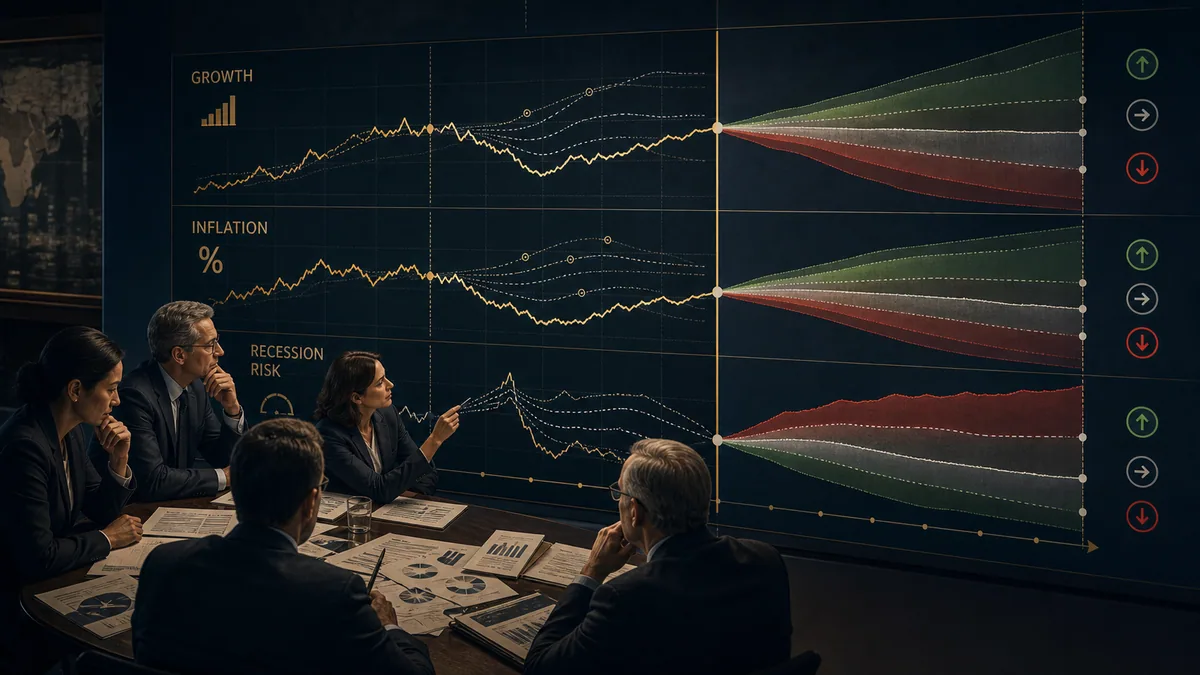
An original visualization of forecast revisions, alternative scenarios and the limits of economic certainty.
SALGIL original illustration · record sources below ↗05 · DOCUMENT TIMELINE
When the record changed
- Earliest reviewable baselineIMF World Economic Outlook anchors the first layer used on this page.
- Interpretation expandsInitial release · data revision · forecast update · outcome
- Claim meets outcomeForecast errors rise with horizon and crisis; later revisions must not replace the original forecast in scorekeeping.
- SALGIL editorial reviewOriginal, interpretation and outcome are retained as separate records.
06 · EDITION AND WITNESS COMPARISON
How the evidence for Economic Forecasts and Their Limits changes
The date of a document and the date of an interpretation are recorded separately.| Witness or edition | Date | Editorial status | Why it matters |
|---|---|---|---|
| IMF World Economic Outlook | 20th century–present | Baseline source | Point estimates should be read with ranges and updated vintages. |
| Scholarly or institutional interpretation | Later review | Context layer | Explains language, history and uncertainty without becoming the original text. |
| Viral quotation or modern event match | Recent circulation | Derivative layer | Most vulnerable to translation drift, omitted failures and hindsight; compare with IMF World Economic Outlook. |
07 · MAJOR CLAIMS
Representative claims and their limits
Central claim
Growth, inflation and recession paths can be estimated from current conditions.
Original-first test
The claim is checked against IMF World Economic Outlook, not against a later summary.
Outcome test
Forecast errors rise with horizon and crisis; later revisions must not replace the original forecast in scorekeeping.
08 · WHAT ACTUALLY HAPPENED
Comparison with events
Forecast errors rise with horizon and crisis; later revisions must not replace the original forecast in scorekeeping.09 · DISPUTES AND COUNTERARGUMENTS
Where interpretation changes
The main dispute concerns the distance between 20th century–present and Initial release · data revision · forecast update · outcome. Translation, selective quotation, changed definitions and hindsight can make a broad record appear more exact than it was. Competing readings are therefore preserved rather than silently merged.10 · EVIDENCE SCORE & PROVISIONAL CONCLUSION
Data-rich · error unavoidable
Economic forecasts use models and judgment but face shocks, revisions and feedback from policy. SALGIL's provisional score reflects source traceability and testability, not religious worth or cultural importance.11 · SOURCES AND REVIEW