ENGLISH RECORD 01
Tui Bei Tu Special Archive
推背圖 · Back-Pushing Pictures01 · WHAT IT IS
Overview
An atlas of all sixty figures in the 1915 Seven Chinese Prophecies edition, separating the Li Chunfeng–Yuan Tiangang attribution, Jin Shengtan commentary and modern flood, Taiwan and world-war readings.
02 · ORIGINAL TEXT AND EARLIEST SOURCE
What can be traced?
03 · HISTORICAL BACKGROUND
The world behind the text
TUI BEI TU SPECIAL ARCHIVE · 推背圖
Before interpreting an image, establish when that image existed
Tui Bei Tu combines pictures, cryptic statements, verse and hexagrams across sixty figures. Tradition attributes it to Tang figures Li Chunfeng and Yuan Tiangang, while the familiar sequence and Jin Shengtan-attributed commentary are documented through much later witnesses.
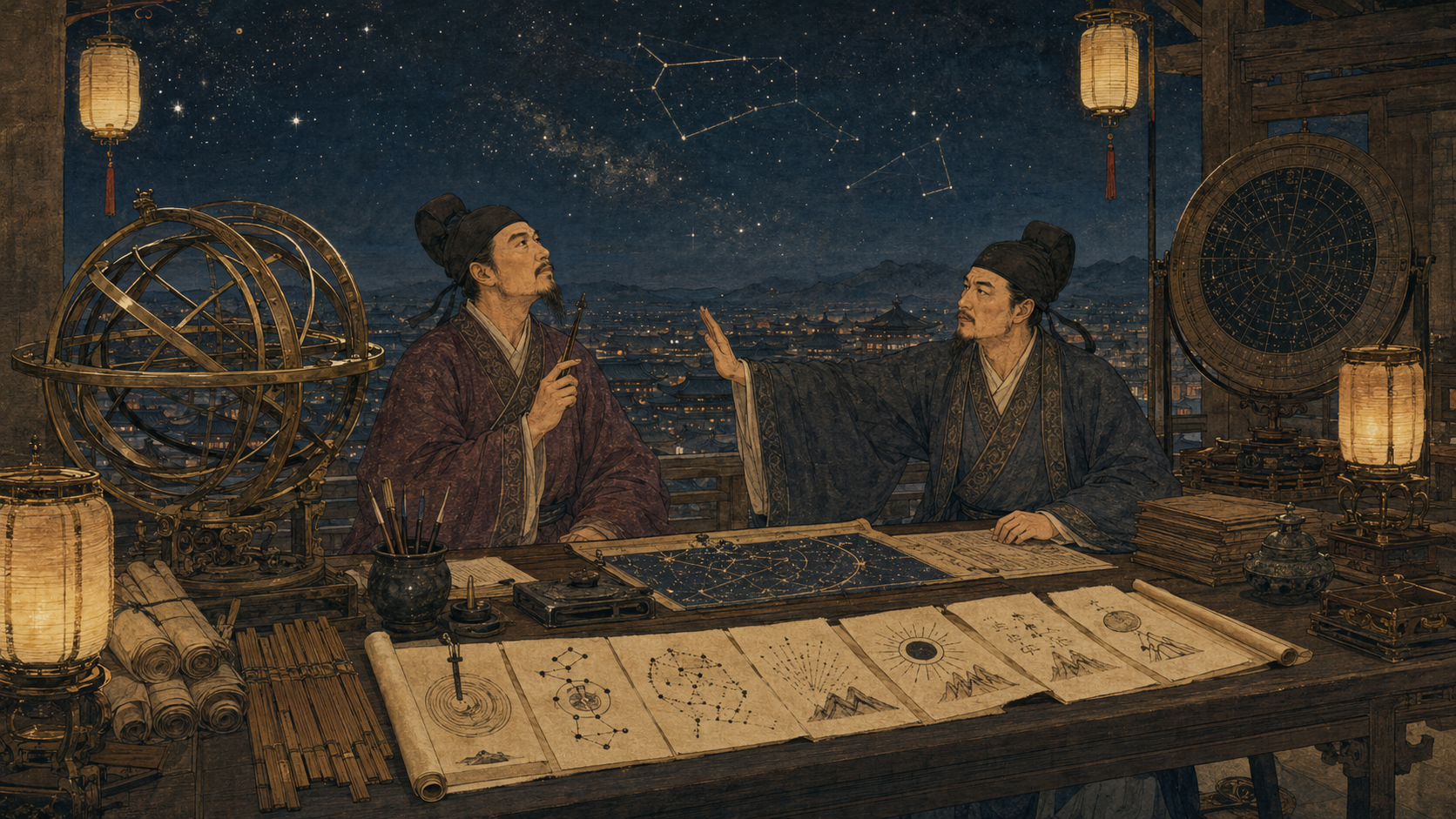
Two Tang figures and a later commentator
A documented Tang scholar associated with calendrics, astronomy and mathematics. Attribution of the surviving Tui Bei Tu requires its own evidence.
Remembered as a physiognomist and divination expert. Biographical tradition does not by itself authenticate the surviving sixty-figure text.
The famous critic's name is attached to the commentary, but whether the entire received layer is genuinely his remains an edition question.
EDITION GENEALOGY
‘The original Tui Bei Tu’ is not one fixed document
Tang authorship tradition
No surviving Tang original establishedSource of authorial prestige
Several manuscript lines
Images, order and wording varyAllows comparison of rearrangement and later insertion
Library of Congress manuscript
Catalogued as imitating a 1633 lineA material witness available for direct inspection
Seven Chinese Prophecies edition
Edited by Qingxi sanren; commentary attributed to JinMain baseline for today's sixty-figure sequence
ANATOMY OF A FIGURE
Separate four layers within every figure
Image
People, animals, objects and spatial relations
Chen
Short compressed statement of omens
Song
Verse, usually four lines, expanding the image
Hexagram and cycle
Yijing figure plus a sexagenary-cycle label
SIXTY-FIGURE ATLAS · 1915 BASELINE
Index of all sixty figures
Numbers, cycle labels and hexagram names follow the 1915 Jin-commentary edition in Seven Chinese Prophecies. Other witnesses need not share this order.TWELVE PLATE STUDIES
Twelve key figures: text and interpretive boundary
Text excerpts come from the baseline edition. Historical commentary, modern claim and SALGIL assessment remain separate layers.01䷀Heaven, earth and recurrence甲子 · 乾Text verified
茫茫天地 不知所止 / 日月循環 周而復始自從盤古迄希夷… 試於唐後論元機- Received or modern reading
- A programmatic opening about the recurrence of heaven, earth, sun, moon and political change rather than one dated event.
- Verification boundary
- Separate a general cycle model from a specific forecast.
02䷫Fruit and the Tang line乙丑 · 姤Retrospective commentary
纍纍碩果 莫明其數 / 一果一仁 即新即故萬物土中生 二九先成實 / 一統定中原 陰盛陽先竭- Received or modern reading
- The 1915 commentary links the fruit to the Li imperial house, Tang rulers and Wu Zetian.
- Verification boundary
- The key question is whether this reading predates the history it explains.
03䷠Sun and moon in the sky丙寅 · 遯Character reading
日月當空 照臨下土 / 撲朔迷離 不文亦武參遍空王色相空… 喔喔晨雞孰是雄- Received or modern reading
- A famous character-reading case that connects ‘sun and moon’ and 武 with Wu Zetian.
- Verification boundary
- Character decomposition becomes flexible unless the rule is fixed in advance.
05䷓An Lushan rebellion and Yang Guifei戊辰 · 觀Witness date required
楊花飛 蜀道難 / 截斷竹簫方見日漁陽鼙鼓過潼關… 定於此處葬金環- Received or modern reading
- Yang, Shu roads, Yuyang and Tong Pass are read against the rebellion, imperial flight and Yang Guifei's death.
- Verification boundary
- The clues are specific, but the witness must be dated before the event.
21䷨The Jingkang crisis甲申 · 損Historical mapping
空厥宮中 雪深三尺 / 吁嗟元首 南轅北轍妖氛未靖不康寧… 卜世三六又南行- Received or modern reading
- The commentary maps the lines to the Jin invasion, Huizong's abdication and the emperors' removal north.
- Verification boundary
- A persuasive retrospective explanation is not automatically a prior prediction.
32䷯Fall of the Ming乙未 · 井Past by 1915
馬跡北闕 犬嗷西方 / 八九數盡 日月無光楊花落盡李花殘… 太息金陵王氣盡- Received or modern reading
- The commentary identifies rebel upheaval, the Chongzhen emperor's death and the brief Southern Ming.
- Verification boundary
- All were past events by the 1915 publication; classify this as retrospective mapping.
33䷛Qing entry into China丙申 · 大過Dating is decisive
黃河水清 氣順則治 / 主客不分 地支無子天長白瀑來 胡人氣不衰- Received or modern reading
- The commentary reads host and guest changing places as the Manchu entry and Qing rule.
- Verification boundary
- Its detailed fit also raises the possibility of Qing-era or later editing.
34䷸Flood, war and catastrophe丁酉 · 巽Interpretive boundary
頭有髮 衣怕白 / 太平時 王殺王太平又見血花飛… 洪水滔天苗不秀- Received or modern reading
- The commentator explicitly says that proving the past is easy and inferring the future difficult, marking a major editorial boundary.
- Verification boundary
- Modern flood and rebellion readings compete; no single target is fixed.
44䷿A sage in China丁未 · 未濟Target unspecified
日月麗天 群陰懾服 / 百靈來朝 雙羽四足而今中國有聖人… 否極泰來九國春- Received or modern reading
- The line about a sage in China is repeatedly attached to leaders, religious figures and reformers.
- Verification boundary
- With no name, date or testable action, candidates can change indefinitely.
45䷃A western visitor and war at sea戊申 · 蒙Competing readings
有客西來 至東而止 / 木火金水 洗此大恥炎運宏開世界同… 兵氣全銷運已終- Received or modern reading
- A major modern interpretation zone variously linked to western powers, Japan and world war.
- Verification boundary
- The geographic frame, parties and deadline must be fixed before comparison.
56䷇War without ordinary soldiers己未 · 比Modern technology reading
飛者非鳥 潛者非魚 / 戰不在兵 造化遊戲海疆萬里盡雲煙… 干戈未接禍連天- Received or modern reading
- Frequently linked online to aircraft, submarines, missiles, nuclear war or autonomous warfare.
- Verification boundary
- Undated metaphor can be reassigned to each generation's newest weapon.
59䷞All under heaven as one family壬戌 · 咸Insufficient specificity
無城無府 無爾無我 / 天下一家 治臻大化一人為大世界福… 東南西北盡和睦- Received or modern reading
- Used for readings about world government, international institutions or civilizational unity.
- Verification boundary
- An ideal of unity is not testable without an institution, event and deadline.
60䷬Push the back and return to rest癸亥 · 萃Closing plate
一陰一陽 無始無終 / 終者自終 始者自始茫茫天數此中求… 不如推背去歸休- Received or modern reading
- The final plate returns to yin-yang recurrence and the image of one figure urging the other to stop and rest.
- Verification boundary
- Record the title legend separately from the earliest datable naming evidence.
MODERN INTERPRETATIONS
Do not paste the later figures directly onto today's news
Taiwan Strait and unification
Figures 43, 44, 47 and 49 are used differently by competing interpreters.
World war and new weapons
Figures 45 and 56 are mapped to naval, aerial, nuclear or autonomous war.
Great flood and climate disaster
Figure 34's ‘flood reaching the sky’ is connected to floods and climate crisis.
Sage and world government
Figures 44, 47 and 59 are attached to leaders and global unity.
VERIFICATION PROTOCOL
Six steps for judging one figure
- 01Fix the witnessName the manuscript or printed edition
- 02Compare layersRecord image, Chen, Song and hexagram separately
- 03Date the copyShow that the witness predates the event
- 04Date the readingFind the same target identified before the event
- 05Compare all detailsPreserve mismatches beside similarities
- 06Keep falsificationNever delete an expired or failed claim
SALGIL VERDICT · OVERALL
Its cultural importance is immense; Tang authorship and modern hit claims still require separate proof.
The 1915 edition is a real, inspectable historical document. Its persuasive matches to earlier dynastic history do not by themselves demonstrate a seventh-century forecast. SALGIL records figure number, witness, wording and date of interpretation together.SOURCE REGISTER