ENGLISH RECORD 150
The Anunnaki — Between Myth and Alien Theory
Mesopotamian Anuna/Anunnaki traditions · Zecharia Sitchin's Earth Chronicles01 · WHAT IT IS
Overview
Four illustrated chapters retell Zecharia Sitchin's Anunnaki saga as a continuous speculative story, then place a clear verification boundary between its dramatic modern narrative and the surviving Mesopotamian texts.
02 · ORIGINAL TEXT AND EARLIEST SOURCE
What can be traced?
03 · HISTORICAL BACKGROUND
The world behind the text
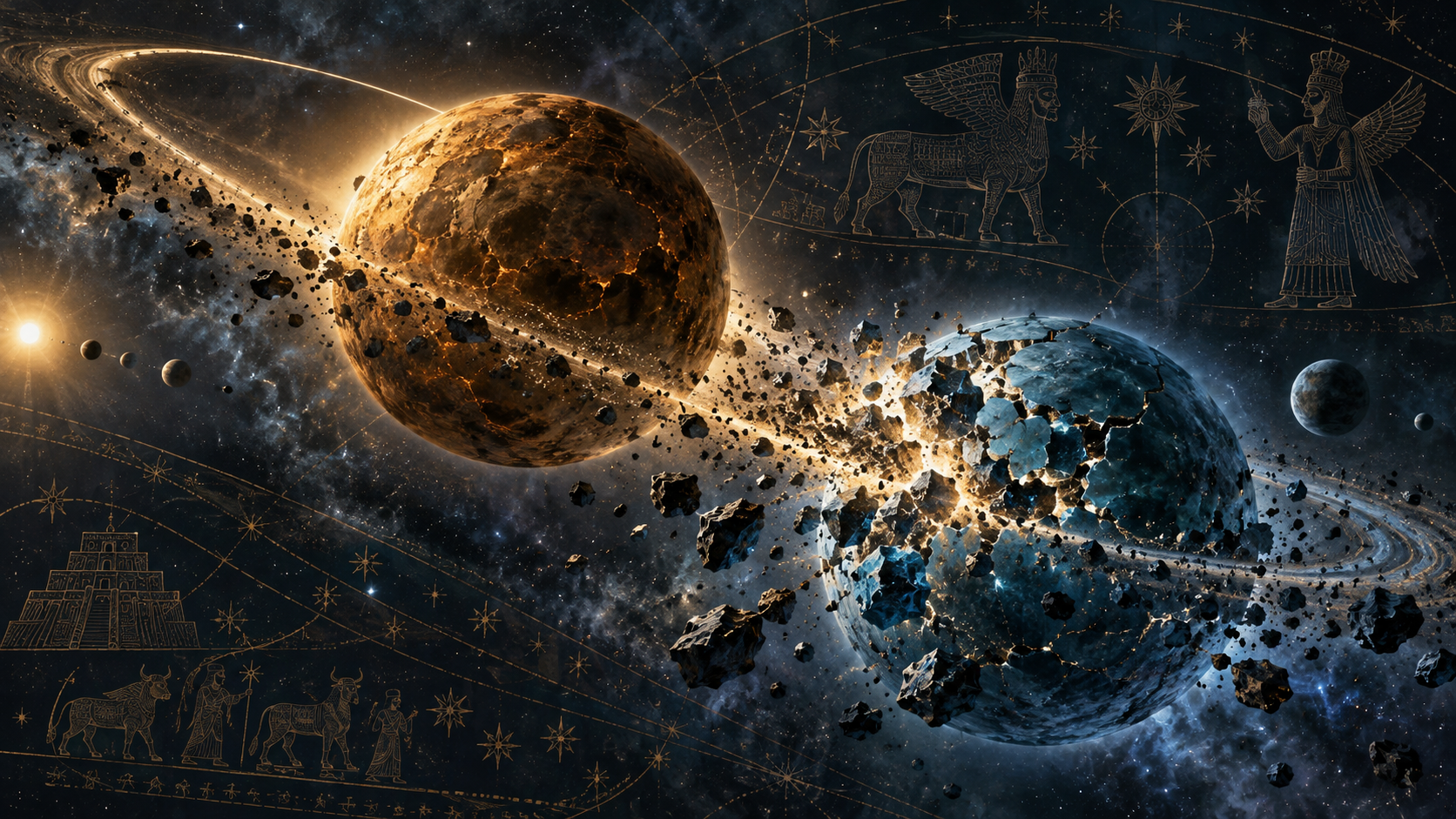
The first of four original images visualizing Zecharia Sitchin's speculative Anunnaki narrative. It is imaginative editorial art, not historical or astronomical evidence.
SALGIL original illustration · generated for this special record ↗05 · DOCUMENT TIMELINE
When the record changed
- Changing Anuna and Anunnaki traditionsThe divine group appears in texts with different members, locations and functions.
- The 12th PlanetZecharia Sitchin joins scattered mythic elements into a technological Nibiru chronology.
- A global media narrativeBooks, television and online culture repeat and expand the alien interpretation.
- SALGIL illustrated reviewFour story chapters are paired with source-specific verification boundaries.
06 · EDITION AND WITNESS COMPARISON
Where the ancient source ends and the modern story begins
The date of a document and the date of an interpretation are recorded separately.| Witness or edition | Date | Editorial status | Why it matters |
|---|---|---|---|
| Cuneiform compositions and lexical sources | Ancient witnesses | Primary textual layer | Document gods, labor, creation and flood motifs in changing religious contexts. |
| Modern scholarly translations and archaeology | Current research | Context and comparison layer | Test language, chronology, monuments and material evidence without assuming extraterrestrial causes. |
| Zecharia Sitchin's Earth Chronicles | 1976 onward | Modern interpretive layer | Provides the continuous Nibiru story but does not become an ancient witness. |
| Television, video and social posts | Later circulation | Derivative layer | Often compress caveats and present the modern synthesis as a literal translation. |
07 · MAJOR CLAIMS
Claims and verification boundaries
Nibiru returns from a distant orbit
In Sitchin's cosmos, a vast wandering world called Nibiru travels beyond the familiar planets. One Nibiruan year equals 3,600 Earth years, and the planet spends most of its long retrograde orbit in cold, distant darkness, sustained by internal heat and a thick atmosphere. In the young solar system it becomes the Marduk of Babylonian myth and confronts the watery world Tiamat. Nibiru's moons strike Tiamat twice: one part is driven into a new orbit as Earth, the debris becomes the asteroid belt, and Tiamat's attendant Kingu becomes the Moon. Seeds of life pass from Nibiru to Earth in the collision, making the two biospheres distant relatives. This ‘celestial battle’ becomes the remote beginning of the later intervention by Anu's sons Enki and Enlil.
An expedition comes to Earth for gold
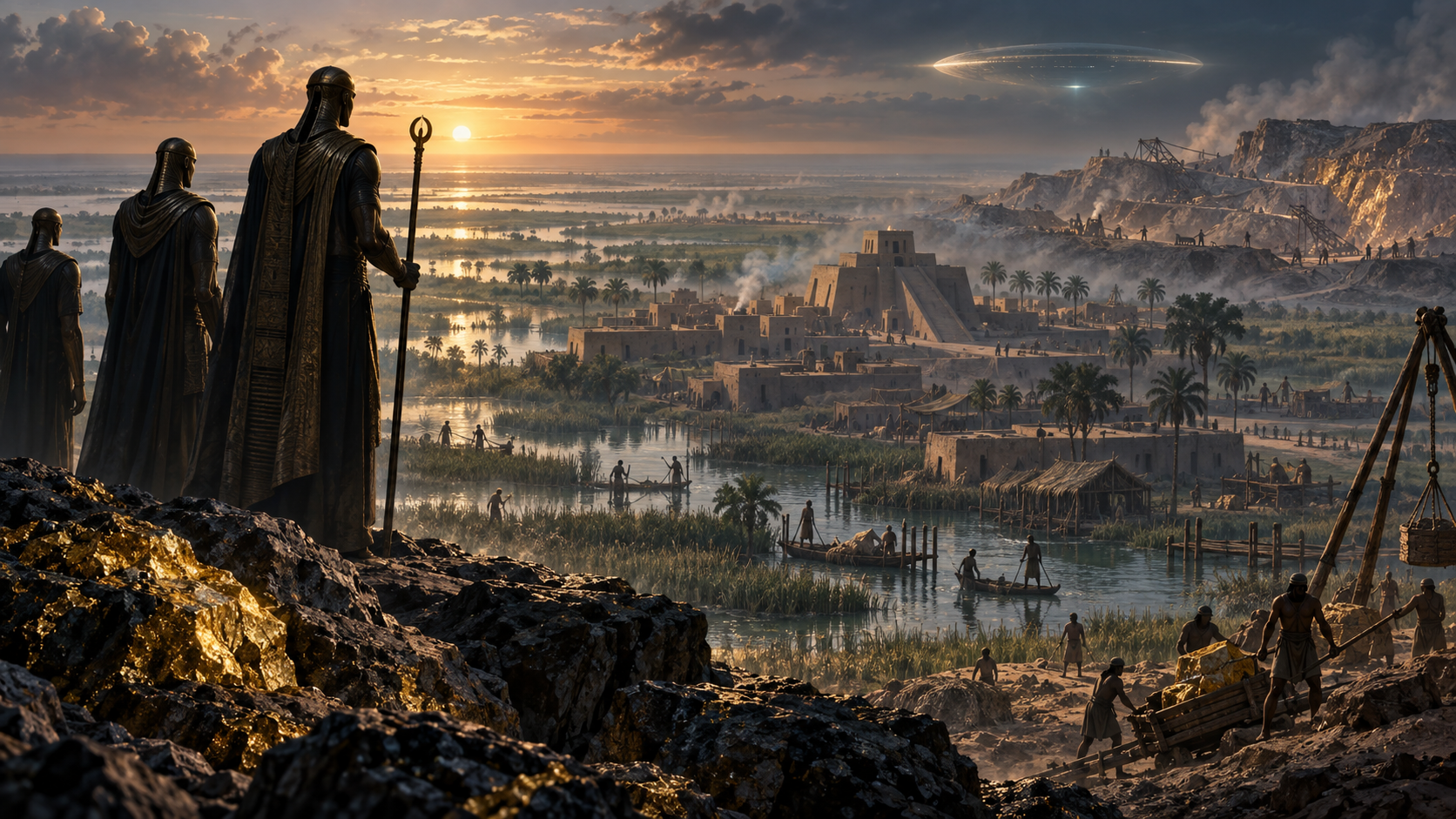
Hundreds of thousands of years later, Nibiru's atmosphere begins to escape. Its rulers plan to suspend fine gold particles high above the planet as a protective shield, but their world lacks enough gold. The exiled rival Alalu flees by spacecraft, discovers gold near the Persian Gulf and changes both worlds' fate. King Anu sends Enki with fifty pioneers, who establish Eridu by the sea. When extracting gold from seawater fails, the mission moves to deep mines in southern Africa's Abzu. Enlil arrives as commander, and the rivalry between brilliant firstborn Enki and legal heir Enlil grows into a struggle over mines, cities and humanity. The Igigi operate orbital stations and a Mars relay while Mesopotamian temple cities become landing fields, control centers and refineries.
The mine revolt and the ‘primitive worker’
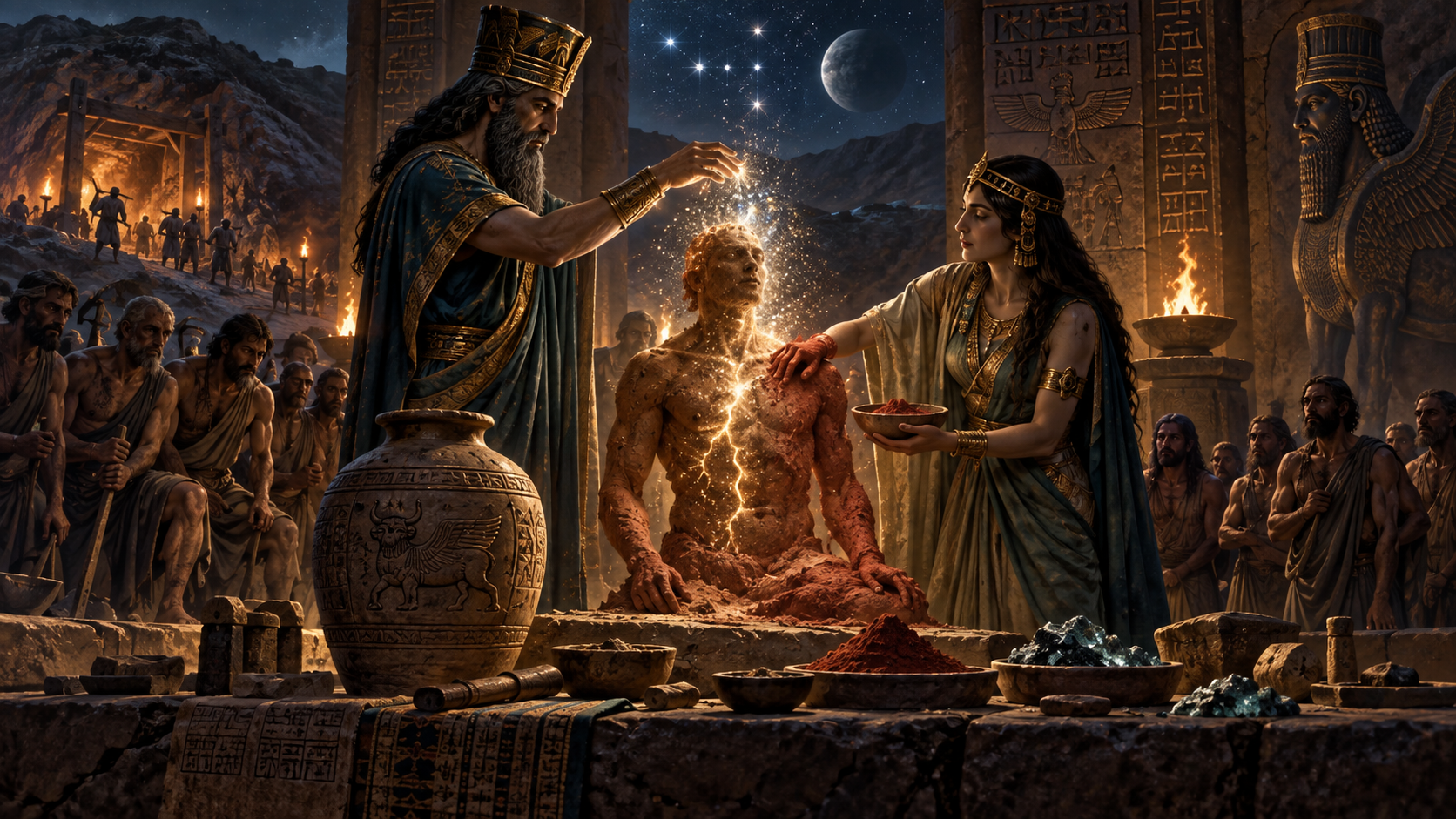
After generations of labor in the African mines, the Igigi burn their tools and surround Enlil's residence. Punishment would end the mining operation, so Enki proposes altering a being already living on Earth to carry the burden. With Ninhursag, associated with birth and healing, he mixes Anunnaki ‘life’ with early humans. Divine blood and wisdom are added to clay, embryos are placed in birth goddesses, and the first successful Adamu—the ‘primitive worker’—is born. At first humans cannot reproduce and must be manufactured repeatedly, but Enki secretly grants fertility. Sitchin recasts Enki as the serpent of Eden and the fruit of knowledge as sexual knowledge and reproductive freedom. Enlil expels the newly independent humans, while unions between Igigi and human women lead into the biblical Nephilim story.
Civilization after the Flood and the final war
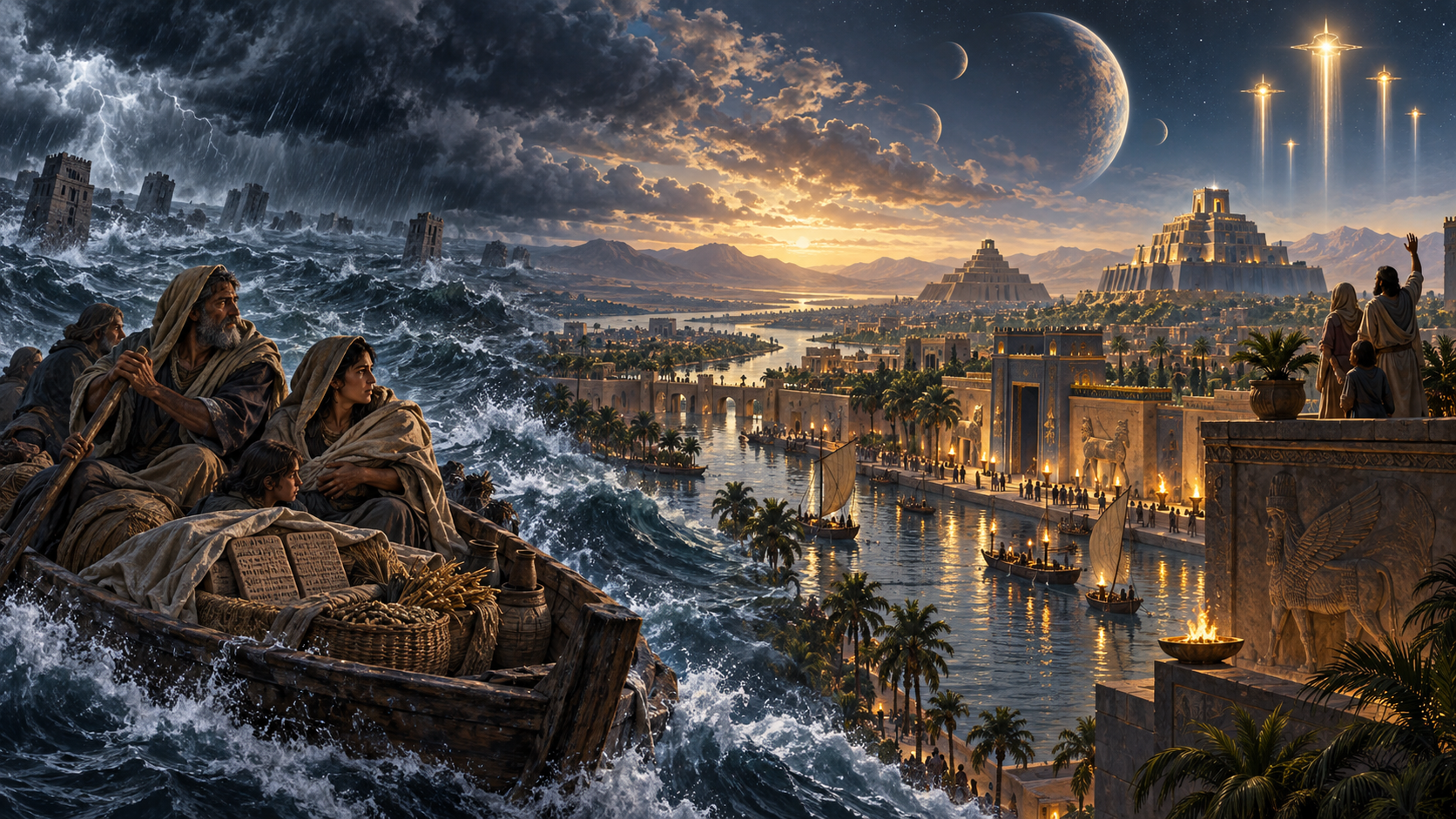
As the human population grows, Enlil fears the loss of control. Nibiru's next passage is said to destabilize Antarctic ice and unleash a global flood. Enlil orders silence, but Enki warns Ziusudra indirectly—speaking to a wall—and has him build a vessel for people and the seeds of life. After the waters retreat, the Anunnaki distribute agriculture, herding, cities, writing and kingship; human rulers govern each god's territory. Baalbek becomes a landing platform, the Great Pyramid a navigation beacon and Sinai a spaceport. The rivalry between the houses of Enki and Enlil culminates in Marduk's bid for supremacy and the ‘Pyramid Wars.’ In Sitchin's chronology, Enlil's faction uses nuclear weapons in 2024 BCE to deny the spaceport, destroying Sodom and Gomorrah. An irradiated ‘evil wind’ sweeps through Sumer; the Anunnaki depart, and humankind preserves only mythic memories of their lost technology.
COMPARATIVE READING
Genesis and Mesopotamian literature
Earlier surviving texts establish a literary background, not a simple verdict of copying. Compare the shared motifs and the different meanings side by side.| Theme | Mesopotamian traditions | Genesis | Assessment |
|---|---|---|---|
| Waters before creation | Order emerges from primordial waters within a world of multiple gods. | God divides and orders the world by speech over the deep and the waters. | Water and ordered creation form a shared background, but divine conflict and one creator's command are different frameworks. |
| Human material and purpose | In Atrahasis, humans are made from clay and the blood of a slain god to carry divine labor. | The human is formed from dust, receives the breath of life and bears God's image with responsibility for the earth. | Clay or earth is shared imagery; human status and the purpose of creation change substantially. |
| Flood and survivor | Atrahasis, Ziusudra and Utnapishtim receive warning and preserve family and life in a vessel. | Noah builds an ark, preserves family and animals, sacrifices afterward and receives a covenant. | The boat, preservation of life and post-flood sacrifice form a strong resemblance, and Mesopotamian versions survive in earlier witnesses. |
| Reason for the Flood | Human noise and growth disturb the gods, who disagree over destruction and rescue. | Human violence and moral corruption bring judgment under one God who also preserves life. | The narrative frame overlaps, but the theological explanation is markedly different. |
| Mortality and life | Gilgamesh seeks immortality but loses a rejuvenating plant to a snake and accepts human limits. | After the forbidden fruit, Adam and Eve are barred from the tree of life and cannot escape mortality. | Lost immortality and a snake appear in both worlds, but the plots and meanings are not identical. |
| City and high tower | Mesopotamian cities used temples and ziggurats to display divine, royal and labor order. | The people of Babel build a city and a tower in Shinar to make a name for themselves. | The story may remember ziggurat culture, but evidence does not identify it securely with one particular monument. |
Old Babylonian Atrahasis tablets, including a British Museum witness dated to 1635 BCE, preserve a flood narrative long before the final form of Genesis. Gilgamesh Tablet XI preserves another Babylonian version.
An older parallel does not reveal which tablet a biblical writer read, whether transmission was direct or indirect, or whether both drew on a wider oral tradition. It also does not establish that every similarity came from one source.
08 · WHAT ACTUALLY HAPPENED
Comparison with events
The surviving sources contain many names and motifs used by Sitchin—Anunnaki, Igigi, divine labor, clay, blood, flood and kingship. The disputed step is the bridge that turns those elements into one technological chronology. No cuneiform sentence independently supplies the full chain of Nibiru planet, gold mission, genetic laboratory, spaceports and nuclear war.09 · DISPUTES AND COUNTERARGUMENTS
Where interpretation changes
The central problem is not whether the name Anunnaki is ancient—it is—but whether modern astronomical and technological meanings can be read back into changing religious texts. Standard philology, archaeology, genetics and planetary astronomy do not support Sitchin's integrated reconstruction. Its power lies in narrative synthesis rather than an authenticated ancient historical record.10 · EVIDENCE SCORE & PROVISIONAL CONCLUSION
Ancient divine name confirmed · alien narrative unsupported
The Anunnaki are genuine deities or divine groups in ancient Mesopotamian religion. The unified story of extraterrestrials from Nibiru, gold miners and designers of humanity is a modern reinterpretation not established by the cuneiform record. Read the four chapters as the story Sitchin assembled, and the verification boundaries as the evidence needed to distinguish it from ancient history.11 · SOURCES AND REVIEW